Felipe Vanni
on 12 April 2023
Phoenix Systems sets a new standard for secure cloud services with Canonical and IBM
Phoenix Systems, a Swiss company, partnered with IBM and Canonical to create a hyper-secure OpenStack cloud focused on data sovereignty and data protection.
Switzerland is a country where data must be hosted within its borders, and for many workloads, public clouds are not an option. Phoenix Systems stepped in to fill this niche by building a hyper-secure cloud within Switzerland that gives customers access to high performance and unsurpassed data protection from a single source.
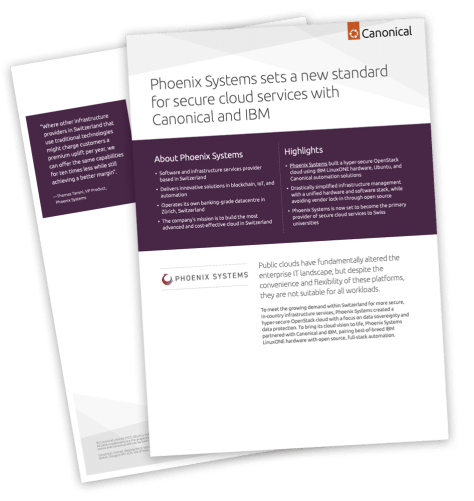
Phoenix Systems used IBM LinuxONE hardware and open-source, full-stack automation from Canonical to create a unified hardware and software stack with automation and orchestration at every level. The company also turned to Canonical to orchestrate and automate its cloud services using MAAS and the open-source application modelling tool Juju.
“Canonical and IBM products always felt like one solution, one environment.”
—Thomas Taroni, VP Product, Phoenix Systems
By using Ubuntu, the dominant Linux operating system in the organisation and among its customers, in both its data centre and on its developer notebooks, Phoenix Systems enjoys a consistent user experience with the same tools across platforms.
With its new infrastructure powered by Canonical and IBM, Phoenix Systems is better positioned than ever to deliver the high availability, speed, and data protection required by its customers whilst streamlined its operations and optimised costs.
“Where other infrastructure providers in Switzerland that use traditional technologies might charge customers a premium uplift per year, we can offer the same capabilities for ten times less while still achieving a better margin”.
Access now the full case study to learn how Phoenix Systems utilised IBM’s confidential computing technology to implement a zero-trust security approach, and Canonical solutions to easily model, configure, deploy, and scale complex OpenStack environments with extensive automation throughout the entire ecosystem.